
Round, Oval, or Square: How to Choose a Seal Shape
You have typed the company name, the preview shows a neat red circle, and the shape menu is offering five other options you had not thought about. It is tempting to treat that menu as a matter of taste. It mostly isn't. Before anyone reads a single character on a seal, they have already read its outline, and the outline tells them what kind of mark they are looking at: an organization's identity, a secondary or specialist seal, a person's name, or a note about the document's status.
Pick the shape that matches the job and the rest of the design gets easier. Pick the one you like best and you can end up with a beautiful mark that sends the wrong signal.
Shape is read before text
People recognize seals the way they recognize road signs: by outline first. A round red ring on a contract reads as "the company"; a small rectangle in blue near the top margin reads as "someone processed this." This happens in a fraction of a second, long before anyone checks the spelling of the name.
That is why the same text can feel official in one shape and casual in another. "Northbridge Trading Ltd" around a ring looks like a corporate seal. The same words in a plain rectangle look like an address stamp. Neither is wrong, but they are different tools, and the reader will treat them differently.
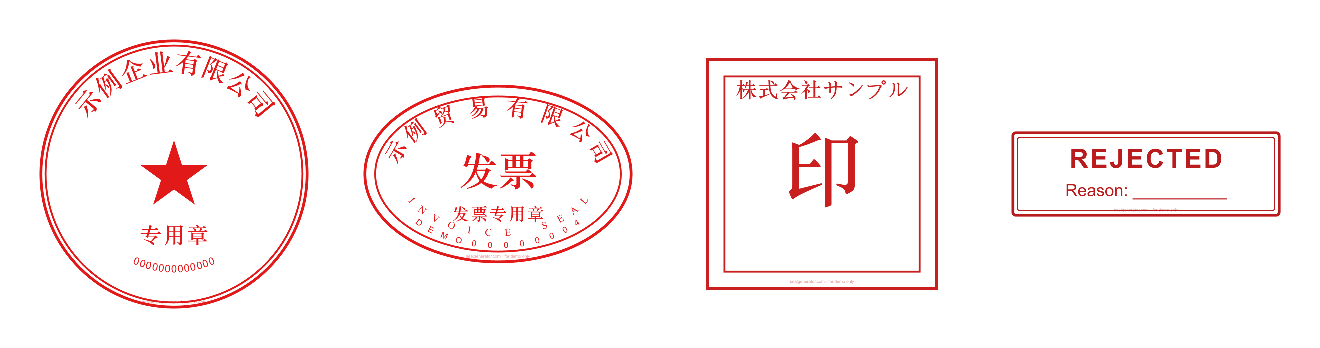
Round: the default for organizations
The circle is the most common seal shape for companies, associations, schools, and public bodies, and there are practical reasons for that.
- Ring text has room. A long organization name can run around the outer edge without being squeezed into tiny type, and the circle gives every character the same visual weight.
- The center is free. A star, emblem, year, or short line of text can sit in the middle without competing with the name.
- It is the expected form. In mainland China, company seals, contract seals, and finance seals are typically round with a five-pointed star in the center. Western embossed corporate seals are round. Many notary and official seals around the world use a circular ring of text, too.
Round is the safe choice when the seal identifies an organization. It is the wrong choice when a mark is meant to be modest, because a round seal borrows authority whether you intend it to or not.
Oval: the secondary seal
Ovals tend to signal "this is a seal, but a specialized one." The most familiar example is the Chinese invoice seal (发票专用章), which is conventionally a horizontal oval; the seal generator includes a 40 × 30 mm oval preset for exactly that use. Some organizations also use ovals for finance or department seals so they are easy to tell apart from the main company seal on a crowded page.
Ovals also suit personal and decorative stamps. The elongated shape holds a single line of text or a name with a small emblem, and it looks less formal than a circle. An upright oval is a common choice for leisure seals in calligraphy and painting, where a round or square frame would feel too heavy.
The trade-off is geometry. Text curving around an oval bends tightly at the ends and loosely along the sides, so spacing needs more care than on a circle. If the ring text looks uneven, shorten it before you start nudging letter spacing.
Square and rectangular: names, status, and process
Squares and rectangles cover two very different jobs.
Personal and representative seals. Across East Asia, personal name seals are traditionally square or close to it, with the characters arranged in a grid rather than a ring. China's legal representative seal is commonly an 18 × 18 mm square. Japan's square company seal (角印) appears on invoices and quotations alongside the round registered seal. A square reads as "a name," and it reads as a person or a role rather than an institution. The personal name seal guide covers how to lay one out.
Workflow and status stamps. APPROVED, RECEIVED, PAID, DRAFT, date stamps, and numbering stamps are almost always rectangular, often with a single border and plain type. The rectangle holds straight lines of text, leaves room for a handwritten date or initials, and, just as importantly, does not look like a company seal. The document control stamps guide explains why that visual distance matters.
Rectangles are also the natural home for address stamps. In India, for example, the everyday company rubber stamp is often a rectangle with the company name, address, and a line for the authorized signatory, because it has to hold far more information than a ring ever could.
Two special forms: riding-seam and watermark
The shape menu in most seal tools includes two options that are not really outlines.
A riding-seam seal (骑缝章, 割印) is a technique rather than a separate design. One seal impression is split across the edges of several pages, so each page carries a slice and the slices only line up when the pages are in their original order. It is common on multi-page contracts in China, Japan, and Korea. You design the seal as usual, usually round, and the PDF stamp tool can split it across page edges for you.
A watermark is a pale, often repeated mark that sits behind the content. It signals a state, such as "sample" or "confidential", across the whole page rather than identifying who issued it. The seal, watermark, logo, or signature guide covers when it is the right choice.
Let the text decide between close options
When two shapes would both be acceptable, the amount of text usually settles it.
On a 40 mm round seal, the ring text sits on a circle about 32 mm across. If the text spans roughly two thirds of that circle, as it typically does when there is bottom text or a star to leave room for, you have something like 65 to 70 mm of arc. That is plenty for six Chinese characters or a short English name. It is not much for "International Engineering and Consulting Services Group Limited," which will turn into a ring of cramped capitals.
Rules of thumb that hold up well:
- Long names belong on a circle or oval, not in a small square.
- Two short lines of text, such as a department and a city, fit better in a rectangle than on a ring.
- Addresses, phone numbers, and registration numbers need a rectangle. Do not try to fit them on a ring.
- A two-to-four character name fits naturally in a square grid.
If the text does not fit the shape the convention calls for, shorten the text before you abandon the convention. The seal fonts guide has more on making type survive at small sizes.
Keep a set of seals coherent
Organizations that use more than one mark should treat shape as a ranking system:
- Round for the main identity seal and its close relatives.
- Oval for specialized seals such as invoice or finance seals.
- Square for personal or representative seals.
- Rectangle for workflow and status stamps.
When shape follows role, a reader can tell the seals apart at a glance, even in a grayscale photocopy. When every seal is round and red, people have to read the bottom text to know which one they are looking at, and sooner or later someone picks the wrong one. The types of company seals guide goes deeper into designing a set.
When convention outranks preference
If you are making a seal for a specific country, institution, or counterparty, the shape is often decided already. A Chinese company seal is round. A Japanese square company seal is square. A Western embossed seal is round. Using a different shape will not make the seal invalid in most situations, but it makes the mark look unfamiliar to exactly the people who are supposed to recognize it.
Before you design, check what the people receiving your documents expect. The guide to why seals look different around the world is a good starting point, and the regional articles go into detail for each country.
Try it before you commit
Shape is easiest to judge by trying it with your actual text. In the seal generator, switch between round, oval, square, and the other shapes while keeping the same wording and watch what happens to the spacing. Then check the result at the size it will really be used, which the seal size and resolution guide explains. If you would rather start from a proven layout, the template gallery has examples of each shape in common styles.
Related guides
- Branch Office Seals: Make Multi-Location Documents Clear Without OverclaimingA practical guide to planning branch and location seals that identify the right office, survive everyday document work, and do not blur approval responsibilities.
- Department Seals: Design a Clear Mark Without ConfusionHow to plan, design, and roll out department or team seals for everyday documents without turning a useful mark into a vague stand-in for authority.
- How to Write a Seal Design Brief That Gets a Usable StampTurn a vague request for a company seal into a practical brief: the job, exact text, hierarchy, audience, output files, and a review that catches problems.